In many industrial production scenarios such as chemical, food and pharmaceutical, beverage brewing, and environmentally friendly water treatment, the internal working conditions of equipment cannot be seen or touched. How to observe the material reaction, liquid level status, and medium flow inside the tank in real time is the key to ensuring safety production and product quality. The clamp flange sight glass acts as a transparent observation window for industrial equipment.
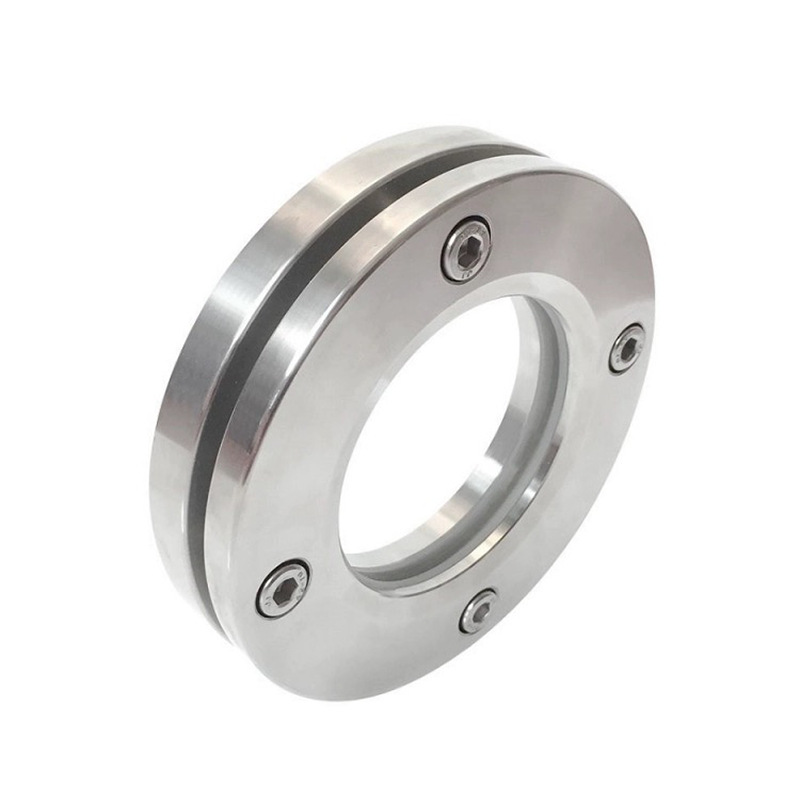
Clamp on flange sight glass, also known as flat clamp on sight glass, is mainly composed of stainless steel flange plate, high-strength tempered glass, sealing gasket, and fastening hexagonal bolts. As shown in the picture, this product has two stainless steel flanges clamped by bolts, and the tempered mirror glass and sealing element are clamped in the middle. The structure is simple and compact, and the sealing pressure is achieved by bolt locking. It can be directly welded or assembled on reaction vessels, storage tanks, pipeline equipment cylinders, allowing operators to see the internal operation of the equipment without opening the cover.
The mainstream material selection is 304 and 316L stainless steel, which is suitable for most working conditions. 304 stainless steel has strong versatility and is commonly used for food and ordinary water treatment; 316L has better acid and alkali resistance and corrosion resistance, making it suitable for chemical and corrosive media environments. The observation glass in the middle is made of pressure resistant tempered glass, and quartz glass can be selected for some working conditions. It is resistant to high temperature and high pressure, impact, and can withstand internal pressure and temperature changes of the equipment; Paired with high and low temperature resistant sealing gaskets, it eliminates the risk of medium leakage and meets hygiene or pressure vessel usage standards.
Its installation method is simple and convenient, belonging to a clamp type structure. Two flanges clamp the glass and sealing gasket, and evenly tighten the hexagonal bolts around to complete the assembly, without the need for complex flange matching. It can be welded to the wall of the tank body and is also suitable for some pipeline working conditions. It has a complete range of conventional specifications such as DN50-DN150, and supports customized non-standard sizes to flexibly match different equipment drilling requirements. During assembly, attention should be paid to evenly locking the bolts diagonally to avoid uneven force that may cause glass stress breakage. This is an important point to note when using the mirror.
Widely used in various industries: food and pharmaceutical industry, observing the fermentation and mixing status of fermentation tank materials, sanitary polishing surface, not easy to accumulate materials, convenient for cleaning and disinfection; In the chemical industry, monitor chemical reactions, liquid levels, and material color changes inside reaction vessels to avoid safety hazards caused by blind operation of sealed containers; In fields such as environmental water treatment, beverages, and grain and oil processing, it is also widely used to monitor the internal working conditions of equipment in real time, detect abnormalities in a timely manner, reduce the risk of equipment failure, and ensure stable production operation.
Many people tend to overlook that mirrors are vulnerable parts. Tempered glass is subject to long-term temperature fluctuations and medium erosion, which poses a risk of aging. Daily inspections should check for cracks in the glass and leaks in the gaskets; Once scratches or cracks appear on the glass, it must be replaced in a timely manner. It is strictly prohibited to continue production with damage to prevent media from spraying out and causing safety accidents.
The small flange mirror may seem inconspicuous, but it is an indispensable component of enclosed industrial equipment. Visualizing the invisible internal working conditions, while considering multiple functions such as pressure sealing, corrosion resistance, and safety observation, builds a visual safety defense line for industrial production, and is truly the "industrial eye" on tanks and reaction equipment.