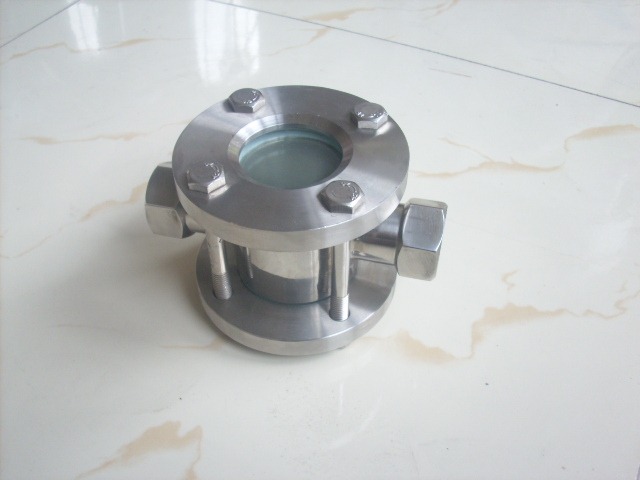
Structure and Principle: The wafer sight glass, a type of straight-through sight glass, utilizes long bolts to clamp and secure the middle flange of the glass plate, forming an observation window. This structure ensures the sight glass is stably mounted on the pipeline and can withstand the pressure of the medium inside the pipeline. It allows personnel to observe the flow state, color changes, and presence of impurities of liquids, gases, steam, and other media inside the pipeline through the sight glass.
Main technical parameters:
Main materials: carbon steel, 304 stainless steel, 316, 321, 316L, etc.
Operating temperature: Depending on the material of the window, it ranges from 0-200℃ for tempered glass, 0-450℃ for high borosilicate glass, and 0-600℃ for quartz glass.
Connection methods: The most commonly used ones include flanges, threads, welding, etc. Other connection methods can also be customized.
Sealing gasket: Generally, polyethylene tetrafluoroethylene (PTFE) sheets are used.
Application areas: It is frequently used in production pipelines for petroleum, chemical, chemical fiber, pharmaceutical, and food industries. It allows for real-time observation of medium flow reactions, monitoring of production, and prevention of accidents during the production process.
Application areas: It is frequently used in production pipelines for petroleum, chemical, chemical fiber, pharmaceutical, and food industries. It allows for real-time observation of medium flow reactions, monitoring of production, and prevention of accidents during the production process.
Installation and usage precautions:
Mirror installation: The connecting flange must be clean and undamaged, and it should be operated by professionals. For threaded connection of the mirror, the thread fit should be checked, and sealing material should be applied to the threads.
Installation of mirror lens: Ensure that the mirror base is flat and smooth, and the sealing gasket between the lens and the mirror base is installed flatly, undamaged, and free of grease. Before tightening the screws, confirm that the mirror and cover are installed correctly, and then slowly tighten the screws.
Pressure range: The sight glass must operate within the permissible pressure range; otherwise, safe operation cannot be guaranteed.
Other considerations: Glass has certain limitations in terms of temperature and pressure resistance. After installation, additional pressure should not be applied to the mirror, as this can cause uneven stress on the mirror, leading to glass breakage. The allowable sudden temperature changes vary depending on the material of the glass, so care should be taken to control the temperature difference to prevent glass breakage due to excessive temperature variation.