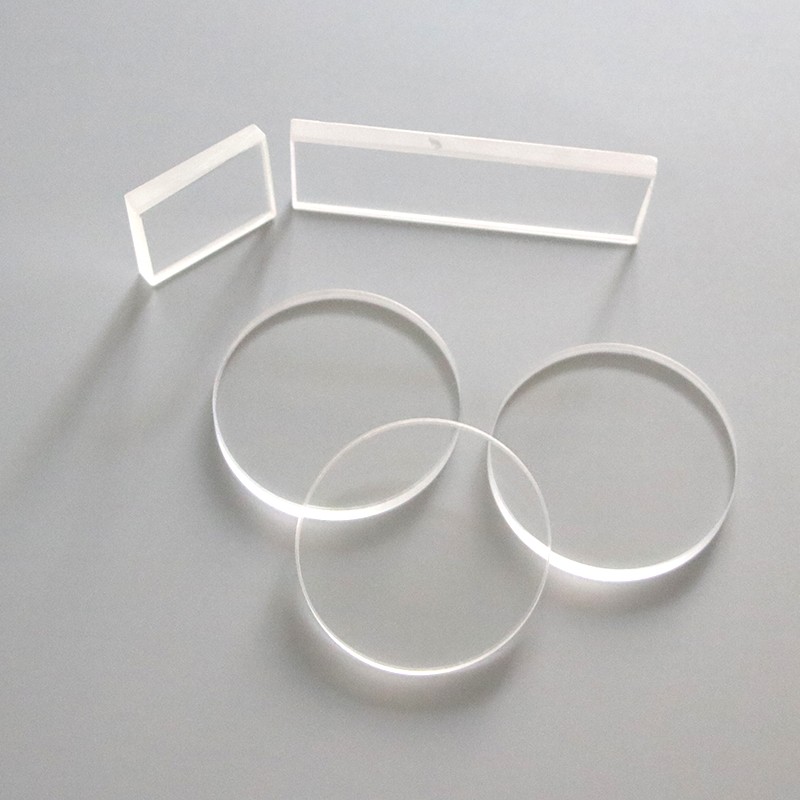
Composition and preparation: Quartz glass is made from various pure natural quartz, such as crystal and quartz sand, or synthetic silane through high-temperature melting. The production methods include electric melting, gas refining, etc. The traditional method is the melting-quenching process, which involves heating the material to the melting temperature and then rapidly cooling it to the solid phase of glass.
Classification: In China, quartz glass is primarily classified based on its manufacturing process, usage, and appearance. Examples include fused transparent quartz glass, continuous-melting quartz glass, gas-refined transparent quartz glass, synthetic quartz glass, opaque quartz glass, optical quartz glass, quartz glass for semiconductor applications, and quartz glass for electric light sources.
feature:
Thermal properties: The thermal expansion coefficient is extremely low, approximately 5.5×10⁻⁷/℃, which is only 1/12 to 1/20 of that of ordinary glass, exhibiting excellent thermal shock resistance.
Optical properties: It exhibits high transmittance across a wide spectral range, from deep ultraviolet (~170nm) to near-infrared (~2500nm). It serves as a crucial material for ultraviolet lamps, space telescope lenses, and laser optical systems.
Chemical properties: It exhibits extremely strong corrosion resistance to most acids and acidic salts, with an acid resistance equivalent to 30 times that of ceramics and 150 times that of stainless steel. However, it can react with hydrofluoric acid and hot phosphoric acid.
Electrical properties: It exhibits extremely high resistivity and maintains good insulation performance even at high temperatures, making it an indispensable carrier material in semiconductor manufacturing processes.
Application areas: Widely used in semiconductors, electric light sources, optical communications, optical instruments, laboratory instruments, medical equipment, and other fields.